
Basilica Cistern History Architecture and Hidden World Beneath Istanbul
Basilica Cistern is located in the Sultanahmet district, directly near Hagia Sophia and the Blue Mosque.
La citerne basilique (Basilica Cistern) se trouve dans le quartier de Sultanahmet, tout près de Sainte-Sophie et de la Mosquée bleue.
La Citerne Basilique est l’un des lieux les plus fascinants et les plus atmosphériques d’Istanbul. Elle offre une perspective totalement différente de celles des grandes mosquées et des palais de la ville. Cachée sous les rues de Sultanahmet, la Citerne Basilique dévoile un monde souterrain mystérieux, façonné par le génie de l’ingénierie byzantine et par des siècles d’histoire.
Au cœur historique d’Istanbul, cette structure exceptionnelle se trouve à seulement une courte marche des principales attractions. Elle est aussi à environ 600 mètres (soit quelque 9 minutes) de l’hôtel Byzantium, ce qui en fait un arrêt simple et indispensable pour les voyageurs qui explorent la vieille ville.
Où se trouve la Citerne Basilique ?
La Citerne Basilique se trouve dans le quartier de Sultanahmet, directement à proximité de Sainte-Sophie et de la Mosquée bleue. Bien qu’elle soit entourée de certains des itinéraires touristiques les plus fréquentés d’Istanbul, la citerne demeure sous terre : elle reste cachée, créant un contraste saisissant entre la ville animée au-dessus et le monde silencieux et sombre en dessous.
Son emplacement central la rend très accessible. Les visiteurs séjournant à Sultanahmet peuvent facilement l’intégrer à leur programme quotidien, sans avoir besoin de transport.
Les origines de la Citerne Basilique
La Citerne Basilique a été construite au VIe siècle, sous le règne de l’empereur byzantin Justinien Ier. Elle servait à stocker et à alimenter en eau le Grand Palais de Constantinople ainsi que les bâtiments situés à proximité.
À l’époque, Constantinople avait besoin d’un système d’eau fiable pour soutenir sa population, en particulier lors des sièges. La citerne faisait partie d’un réseau avancé d’aqueducs et de réservoirs qui permettait à la ville de survivre.
Le nom « Citerne Basilique » vient du fait qu’elle a été construite sous une grande place publique où se trouvait autrefois une basilique. Aujourd’hui, même si la basilique elle-même n’existe plus, la citerne demeure comme un rappel puissant des infrastructures byzantines et de l’organisation urbaine.
Conception architecturale et ingénierie
La Citerne Basilique est une véritable prouesse d’ingénierie. Mesurant environ 140 mètres de long et 70 mètres de large, elle pouvait stocker près de 80 000 mètres cubes d’eau.
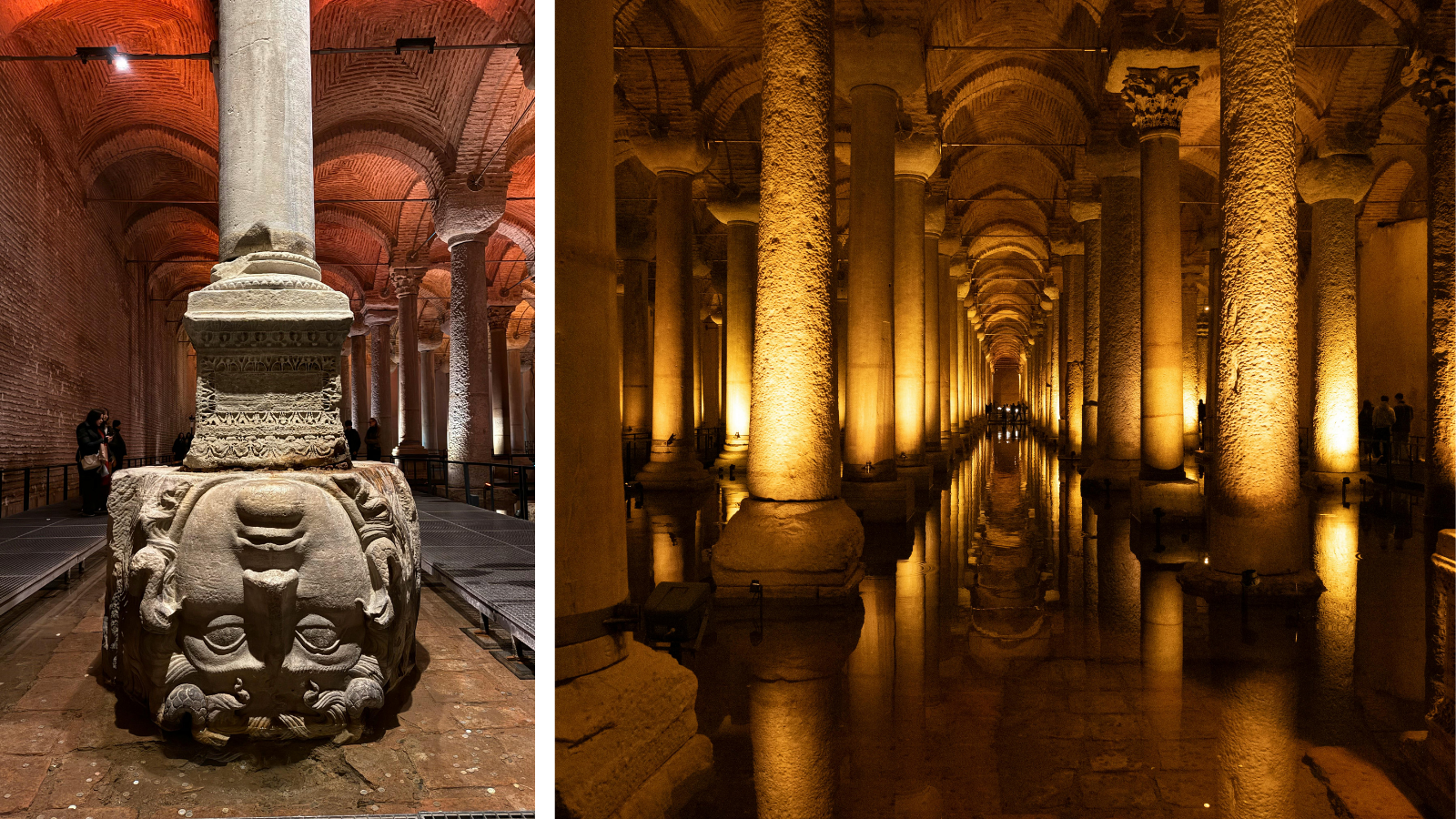
À l’intérieur, la structure est soutenue par 336 colonnes en marbre, chacune haute d’environ 9 mètres. Elles sont disposées en 12 rangées, formant une vaste salle souterraine qui ressemble presque à un palais englouti.
Ce qui rend l’architecture unique :
des colonnes réutilisées provenant d’édifices romains plus anciens (spolia)
chaque colonne présente un style différent et des chapiteaux différents
des voûtes et des arches en briques soutiennent le plafond
l’eau remplissait autrefois tout l’espace
un design à la fois fonctionnel et étonnamment élégant, transformant un simple réservoir en un lieu visuellement captivant
Les célèbres têtes de Méduse
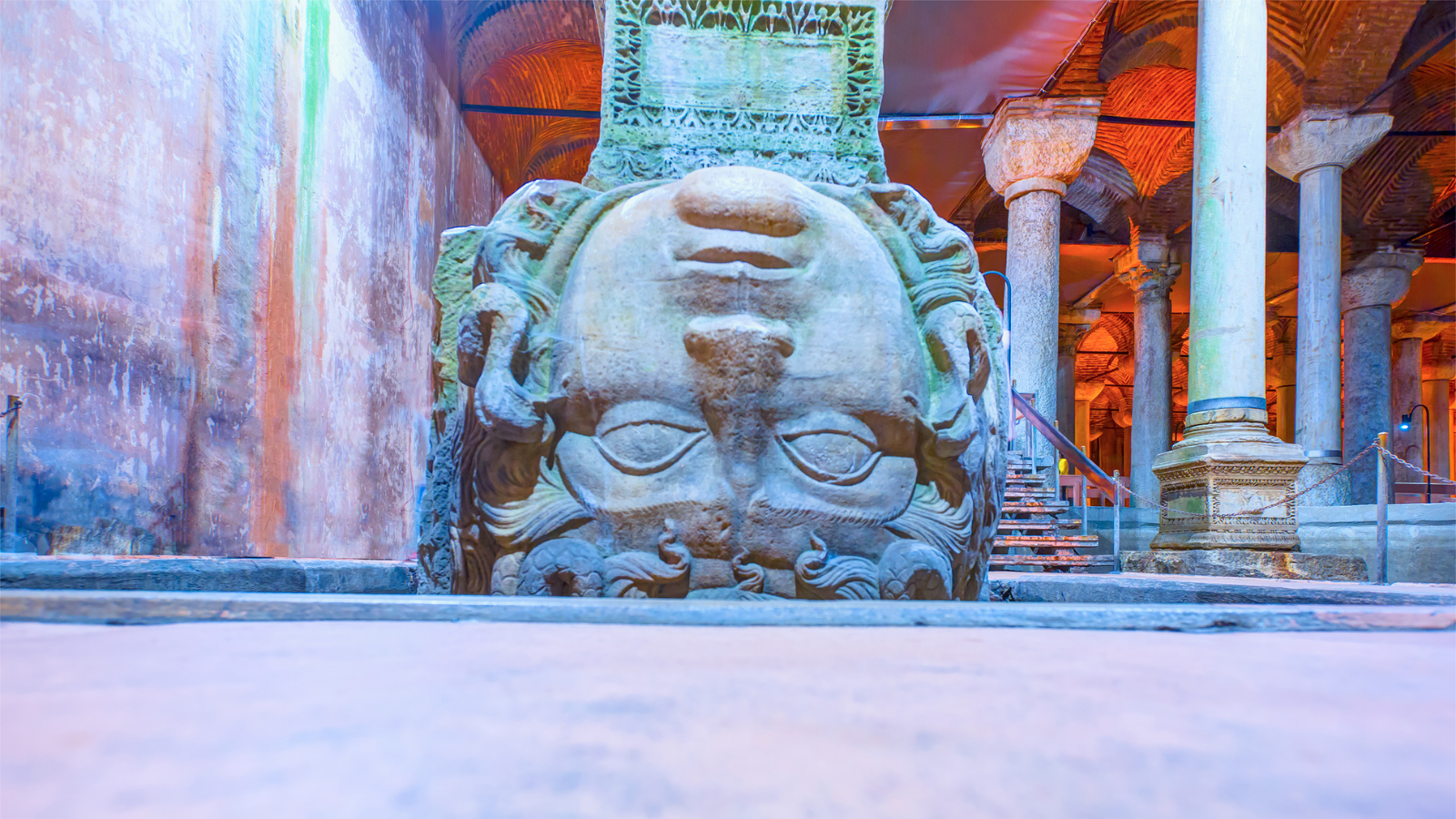
L’un des éléments les plus intrigants de la Citerne Basilique est la présence de deux sculptures de têtes de Méduse, utilisées comme bases de colonnes.
Ces têtes sont placées de manière inhabituelle (l’une sur le côté et l’autre à l’envers), ce qui a donné lieu à plusieurs interprétations et légendes :
certains pensent que cette disposition neutralisait le pouvoir mythologique de Méduse
d’autres estiment que cela a été fait uniquement pour des raisons pratiques de construction
l’origine exacte des sculptures demeure incertaine
Quelles qu’en soient les raisons, les têtes de Méduse sont devenues l’une des parties les plus photographiées et les plus mystérieuses de la citerne.
Ambiance et expérience des visiteurs
Entrer dans la Citerne Basilique est une expérience sensorielle. En descendant sous terre, la température baisse, le bruit s’éloigne et l’éclairage crée une atmosphère dramatique, presque cinématographique.
Éléments clés de l’expérience :
un éclairage tamisé et chaud qui se reflète sur la surface de l’eau
des échos subtils dans tout l’espace
des passerelles surélevées qui guident les visiteurs entre les colonnes
une atmosphère calme et fraîche, même en été
la citerne a aussi été présentée dans des films et dans la littérature, renforçant encore sa réputation
Pourquoi elle était essentielle à Constantinople
La Citerne Basilique a joué un rôle crucial dans la survie de Constantinople. En période de siège, l’accès à une eau douce était indispensable.
Son importance se manifestait notamment par :
l’approvisionnement en eau du palais impérial
le soutien de la ville lors des blocus
la démonstration du niveau avancé de l’ingénierie byzantine
le fait qu’elle s’inscrivait dans un système plus large de distribution de l’eau
Sans des structures comme la Citerne Basilique, maintenir une ville aussi vaste et puissante aurait été beaucoup plus difficile.
Conseils pour la visite
Pour planifier votre visite :
prévoyez 30 à 45 minutes
venez tôt ou plus tard dans la journée pour éviter la foule
portez des chaussures confortables (les passerelles peuvent être légèrement humides)
apportez un appareil photo : la lumière crée de superbes opportunités
Grâce à son emplacement central et à sa proximité avec l’hôtel Byzantium (600 m – environ 9 minutes à pied), elle peut facilement être combinée le même jour avec des visites de Sainte-Sophie et de la Mosquée bleue.
Pourquoi la Citerne Basilique est incontournable
La Citerne Basilique montre Istanbul sous un tout autre visage. Même si la ville est célèbre pour son imposant skyline et son architecture monumentale, cette structure souterraine révèle l’infrastructure cachée qui a soutenu l’une des plus grandes villes de l’histoire.
Ce n’est pas seulement un site historique : c’est une expérience immersive qui mêle ingénierie, mythologie et ambiance. En visitant la Citerne Basilique, vous entrez dans un monde calme et mystérieux sous la surface d’Istanbul, et vous comprenez la ville sous un angle plus profond.
Contact Information
We are happy to assist you with your reservation.
Related Posts
Experience Timeless Elegance in Sultanahmet
Stay at The Byzantium Hotel & Suites, located just steps from Hagia Sophia, Blue Mosque, and Topkapi Palace. Discover comfort, luxury, and authentic Istanbul charm.